2026 Race Intelligence
Japan 2026
A race shaped by sustained structural control rather than abrupt disorder. Antonelli defines the event through persistent field advantage, Russell remains the nearest long-run challenger, Piastri shows competitive potential without full conversion, and Leclerc secures the podium through stronger late-race defence.
Front runners — control layer
Field-relative performance of the leading drivers across the race.
Field Advantage — Front Runners
ANT · RUS · PIA · LEC
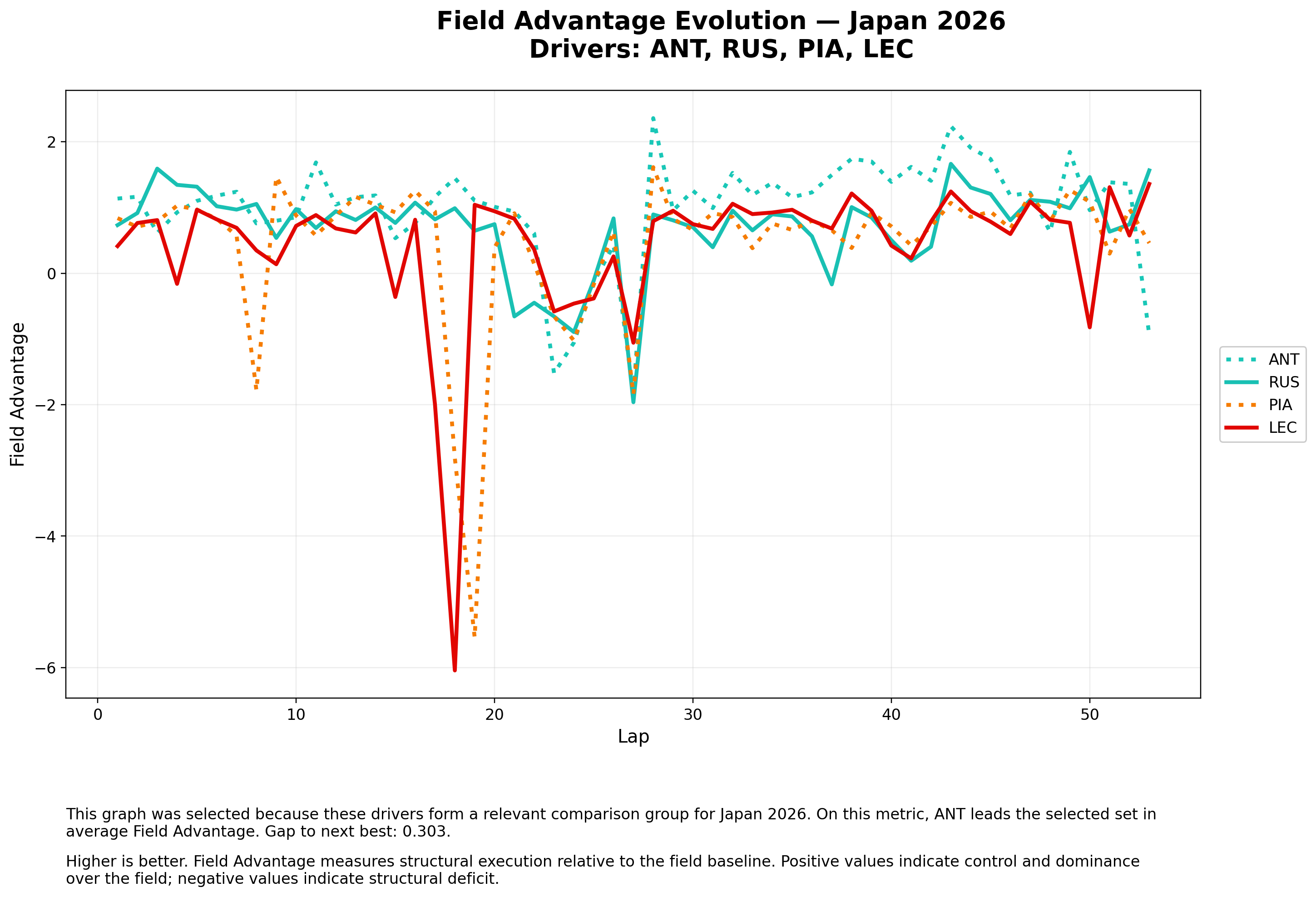
Japan resolves into a clear structural hierarchy. Antonelli holds the strongest race-long control profile, with Russell acting as the closest sustained challenger. Piastri remains competitive across the race, while Leclerc stays within the lead group with greater variability.
Competitive Rank — Front Runners
ANT · RUS · PIA · LEC
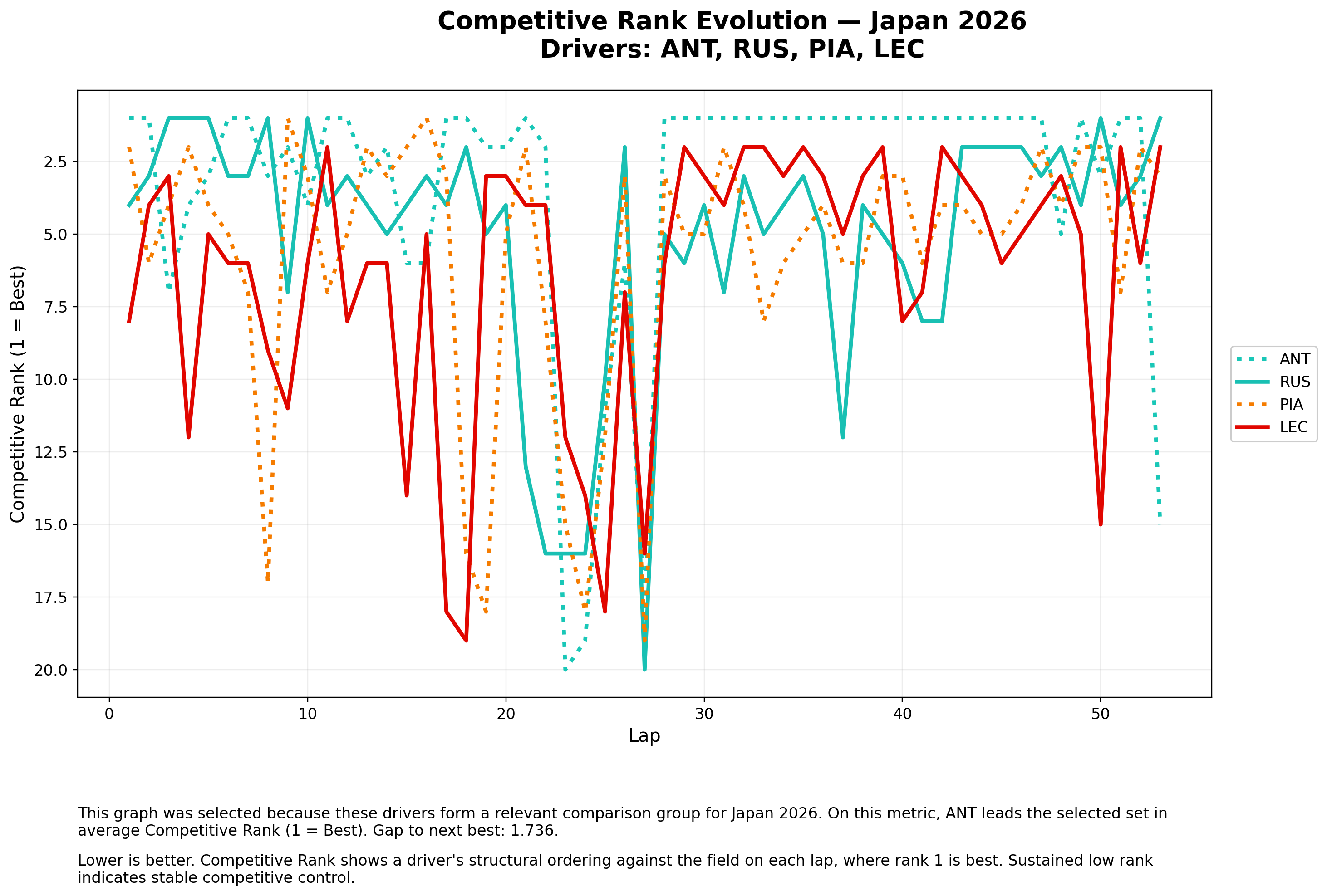
The rank layer confirms the same race structure. Antonelli remains the strongest ordering force across the event, Russell applies intermittent pressure, and the remaining front group does not sustain an equivalent level of control over full distance.
Young drivers — structural profile
Comparative structural behaviour of emerging drivers under the same race conditions.
Field Advantage — Young Drivers
ANT · LIN · HAD · BOR · LAW · COL
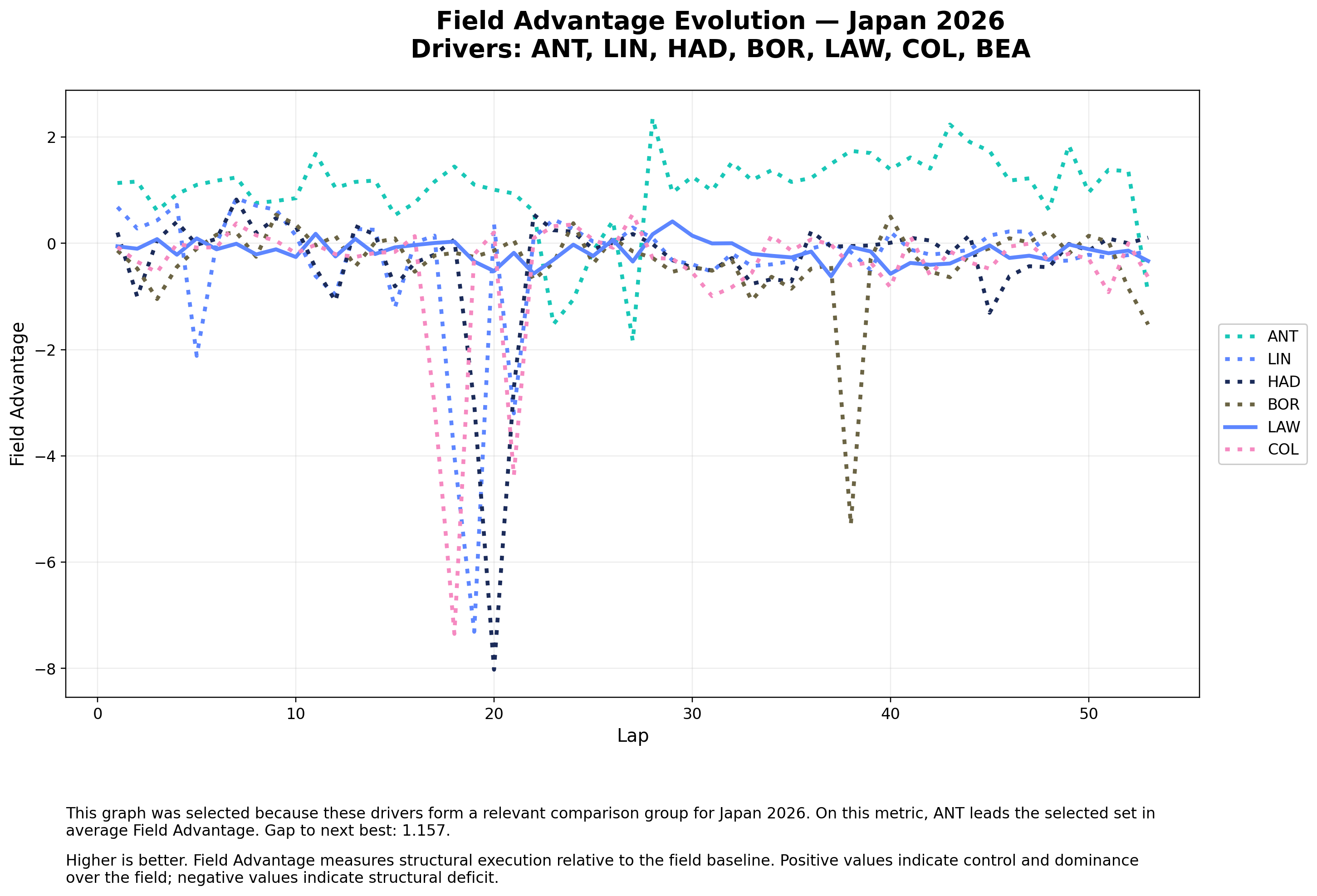
Antonelli clearly separates from the young-driver field through sustained positive field advantage. The rest of the group moves closer to field baseline or below it more frequently, indicating weaker and less stable structural execution.
Competitive Rank — Young Drivers
ANT · LIN · HAD · BOR · LAW · COL
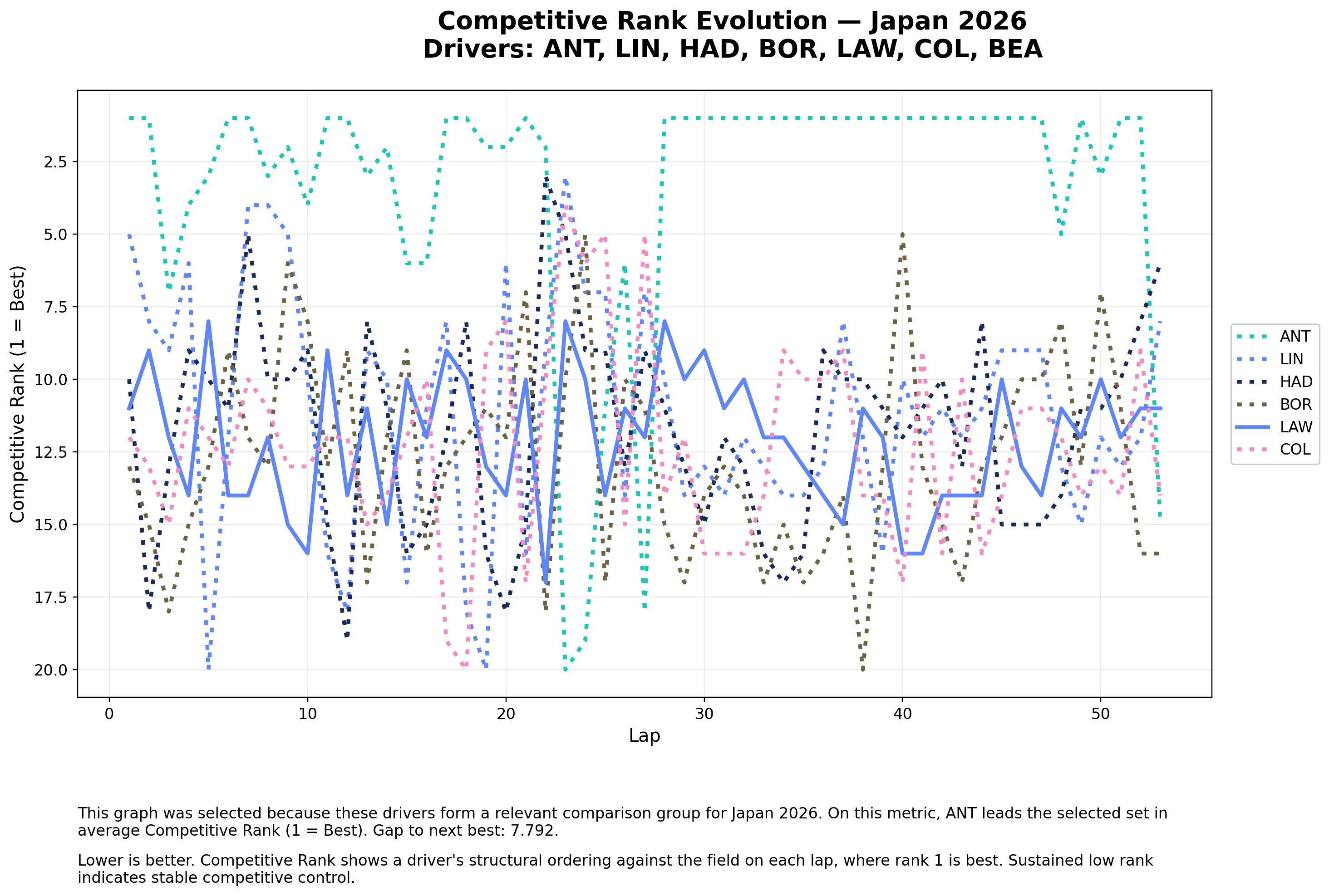
The competitive-rank view confirms the same pattern. Antonelli holds the strongest ordering within the group for much of the race, while the others rotate through more volatile positions and less stable race-state conversion.
Team internal readings
Structural differences inside the leading team groups.
Field Advantage — ANT vs RUS
Mercedes
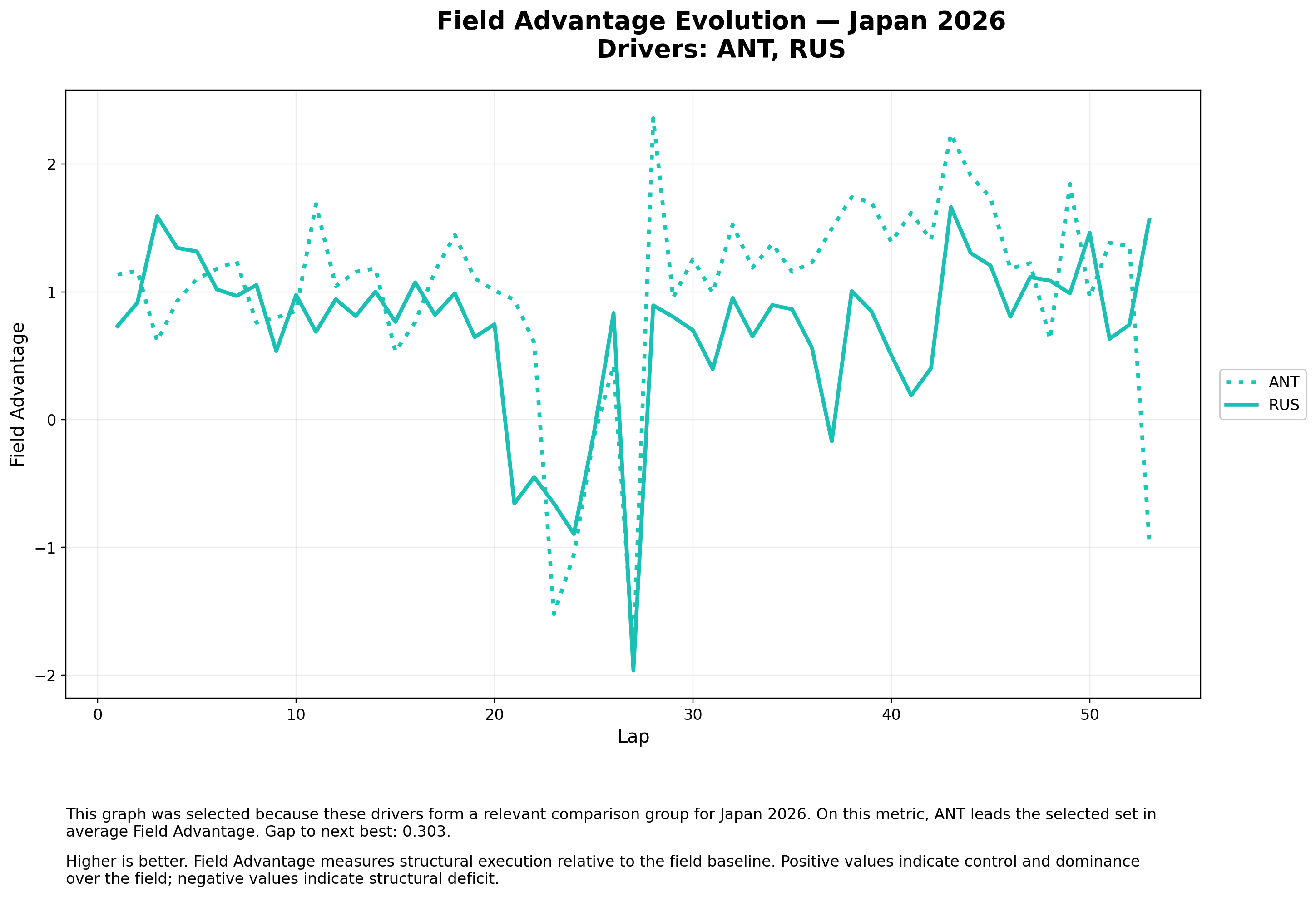
Within Mercedes, Antonelli holds the stronger structural profile over race distance. Russell remains highly competitive, but the advantage signal supports a real separation between the winner and the nearest challenger.
Competitive Rank — ANT vs RUS
Mercedes
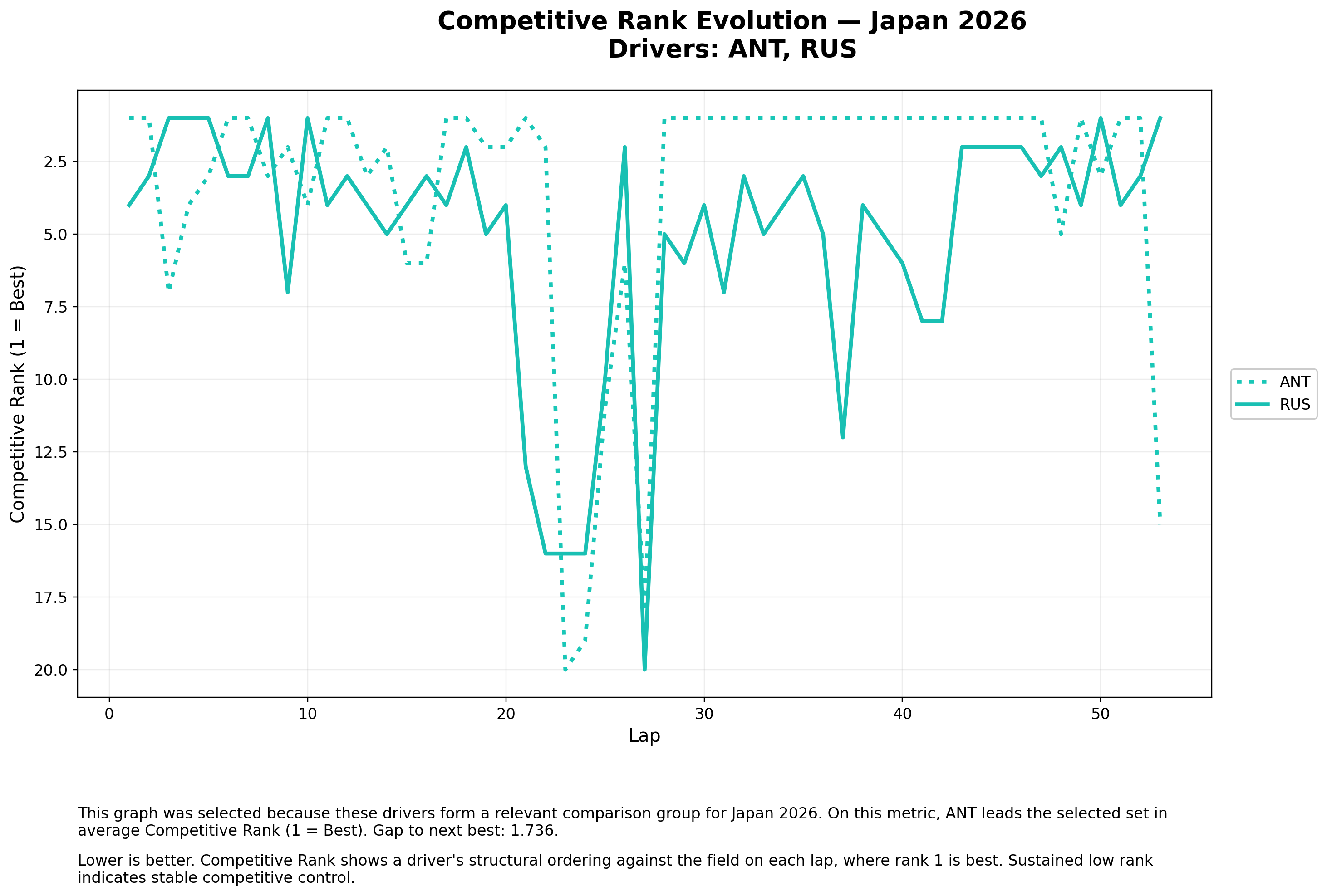
The rank view shows the same internal pattern. Russell applies pressure at intervals, but Antonelli retains the stronger competitive ordering through the decisive layers of the race.
Field Advantage — PIA vs NOR
McLaren
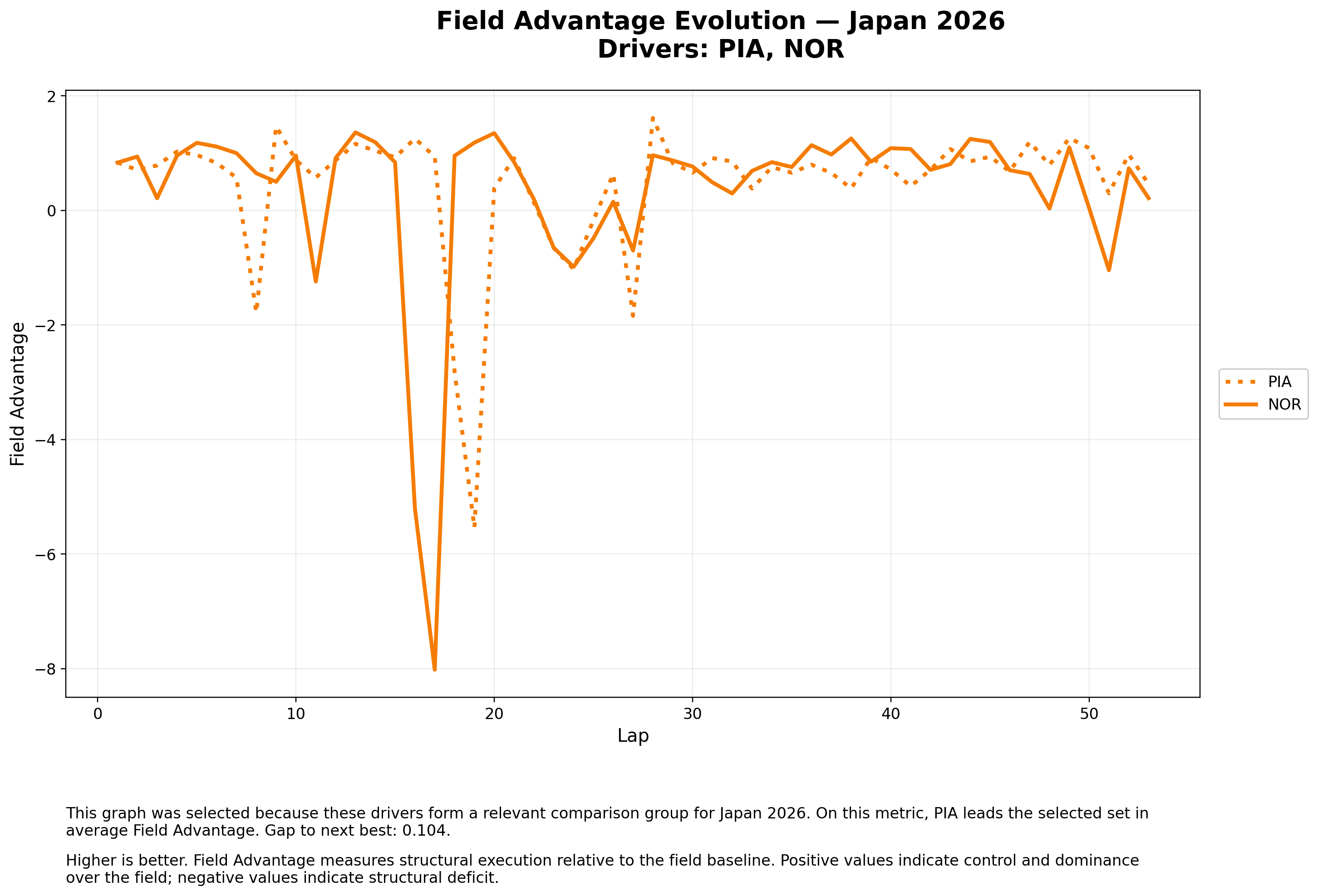
The McLaren pair remains competitive but more variable. Piastri shows real structural strength, yet the profile does not convert into full-race control, and Norris remains within the same unstable competitive band.
Competitive Rank — PIA vs NOR
McLaren
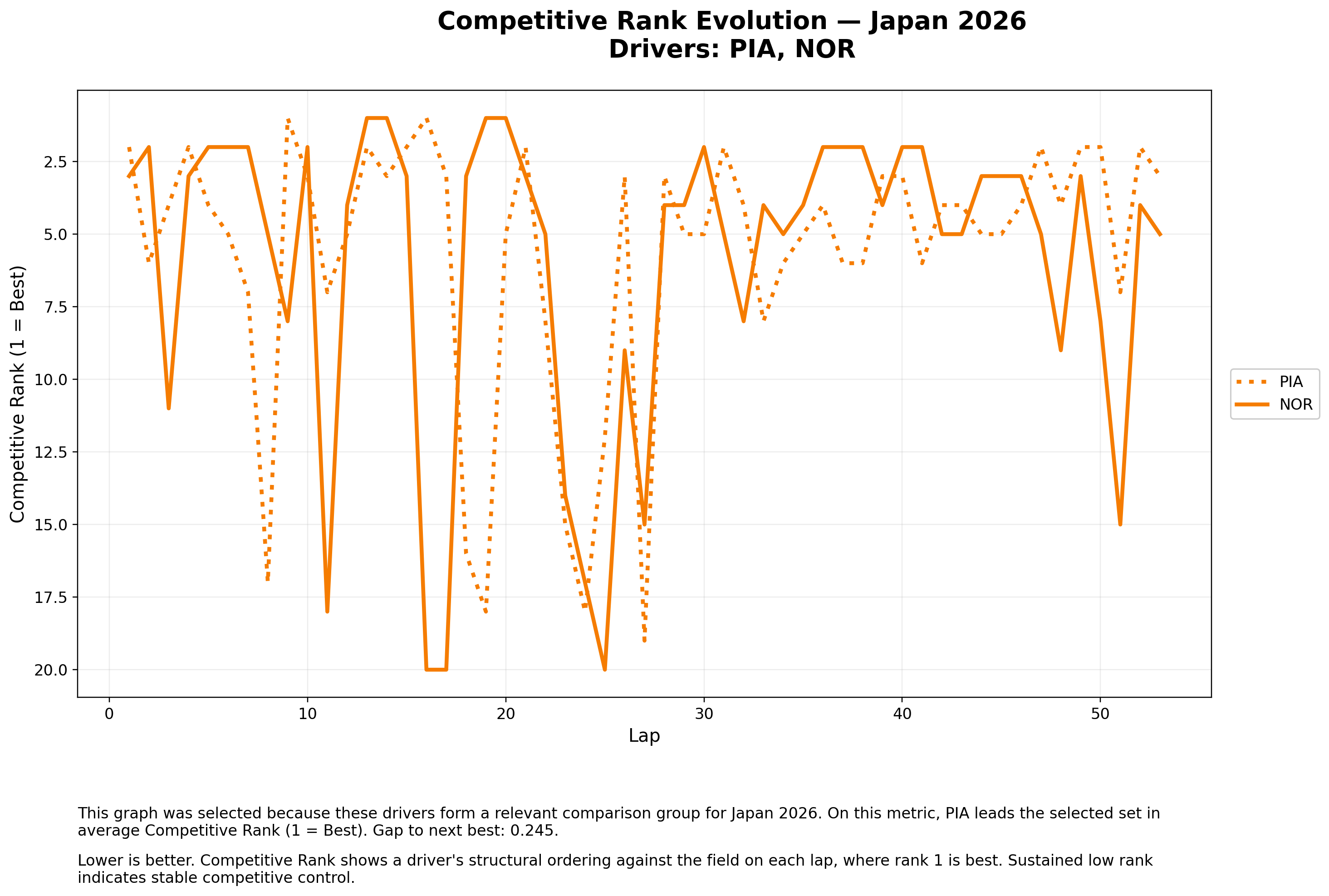
Rank volatility across the McLaren pair reinforces the same reading: competitiveness is present, but neither driver establishes stable command of the race hierarchy.
Field Advantage — LEC vs HAM
Ferrari
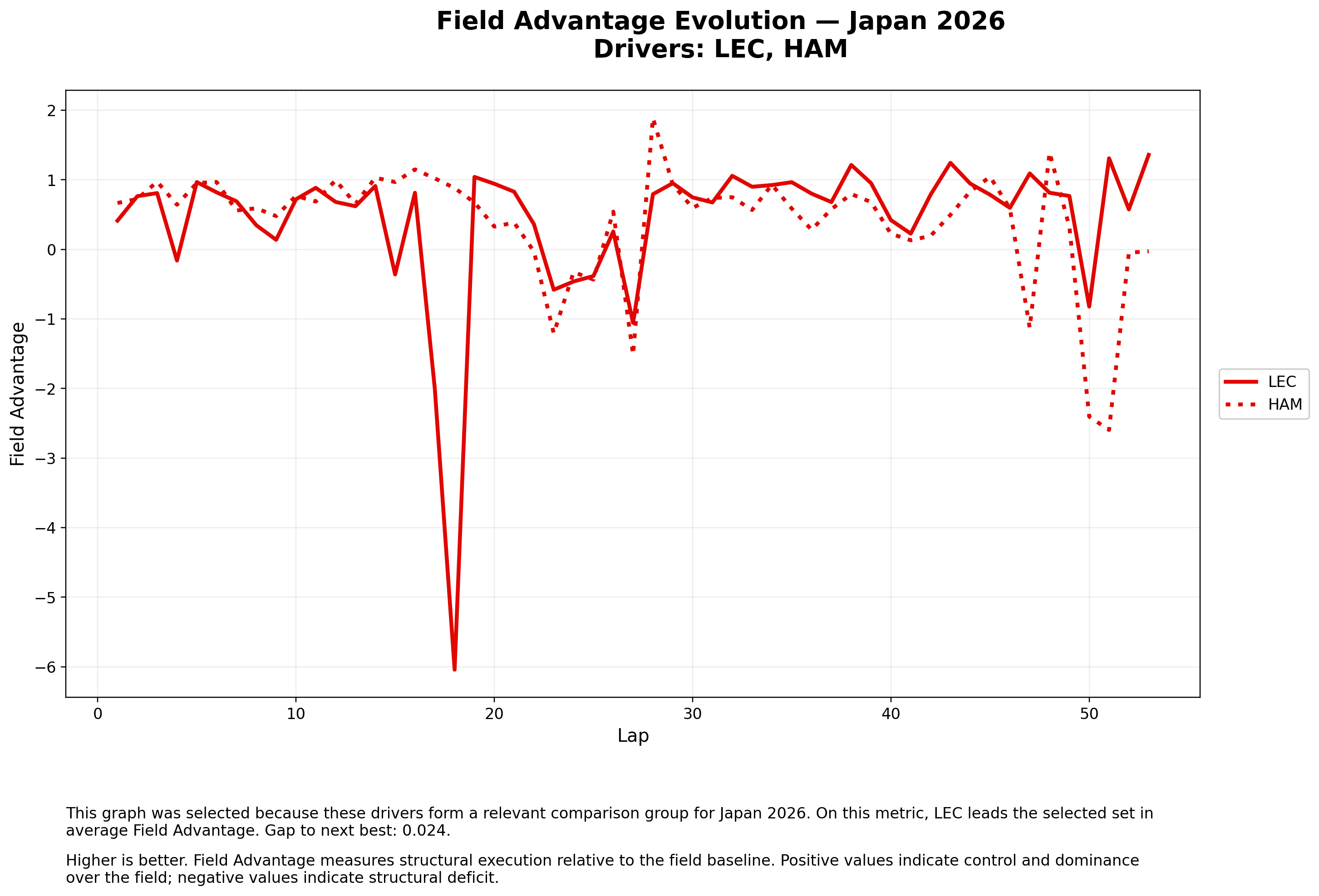
Within Ferrari, Leclerc holds the cleaner late-race structural profile. That supports the interpretation that Ferrari’s stronger closing execution came primarily through Leclerc rather than through a balanced internal pairing.
Competitive Rank — LEC vs HAM
Ferrari
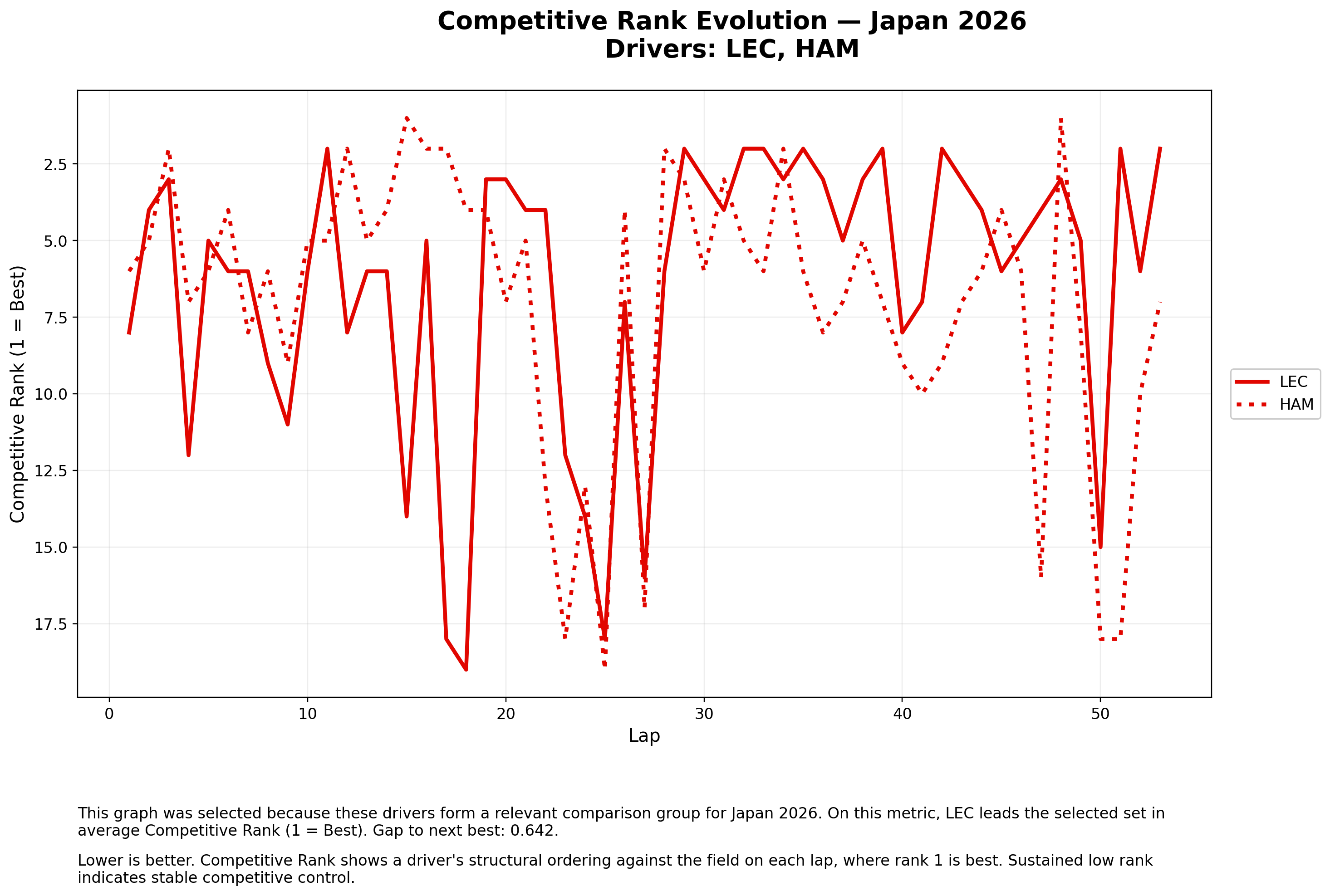
The rank layer supports the podium outcome. Leclerc sustains the stronger ordering under pressure, while Hamilton remains less stable across the same competitive phases.
Battle windows — decisive phases
Focused views of the early contest and the late podium fight.
Field Advantage — Battle Window
ANT · RUS · PIA · LEC · Laps 6–22
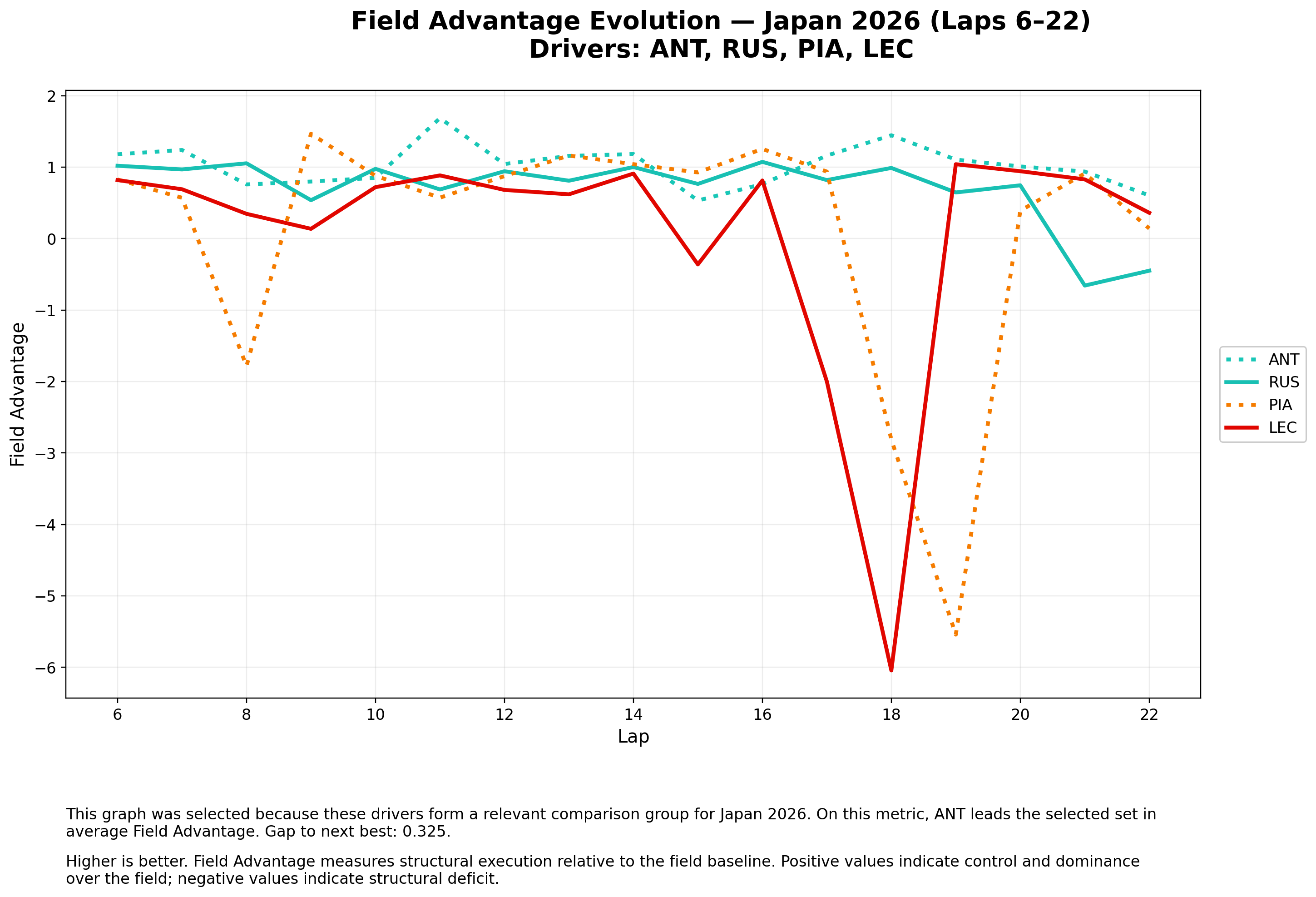
In the early strategic phase, Antonelli remains strongest, but the front group is still meaningfully contested. Russell, Piastri, and Leclerc all remain within reach, which is why this window matters for understanding the event before the race structure fully settled.
Competitive Rank — Battle Window
ANT · RUS · PIA · LEC · Laps 6–22
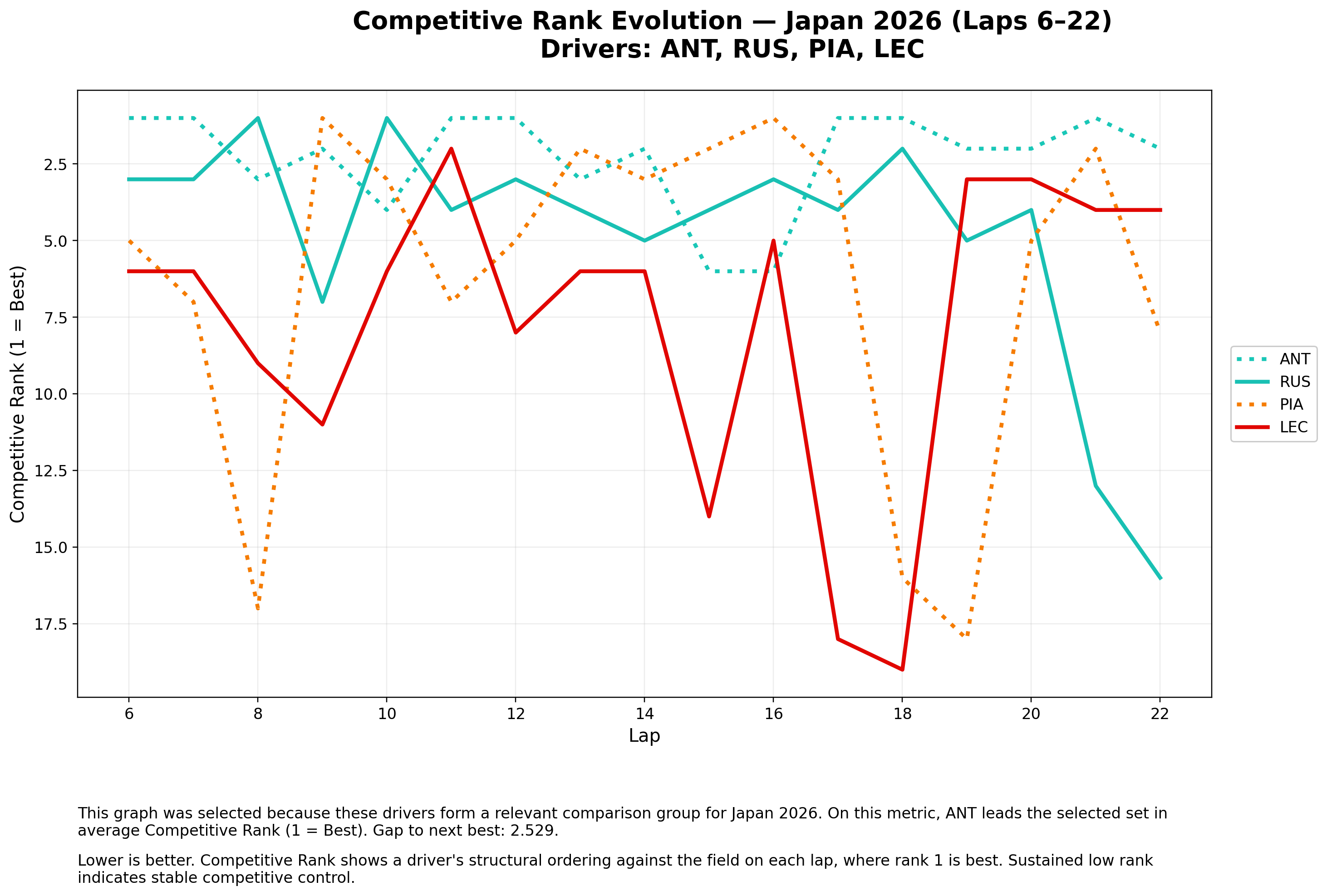
The ordering during laps 6–22 remains active rather than locked. Antonelli is strongest overall, but this phase still contains genuine competitive tension across the lead group.
Field Advantage — Podium Fight
RUS · LEC · HAM · Laps 30–Finish
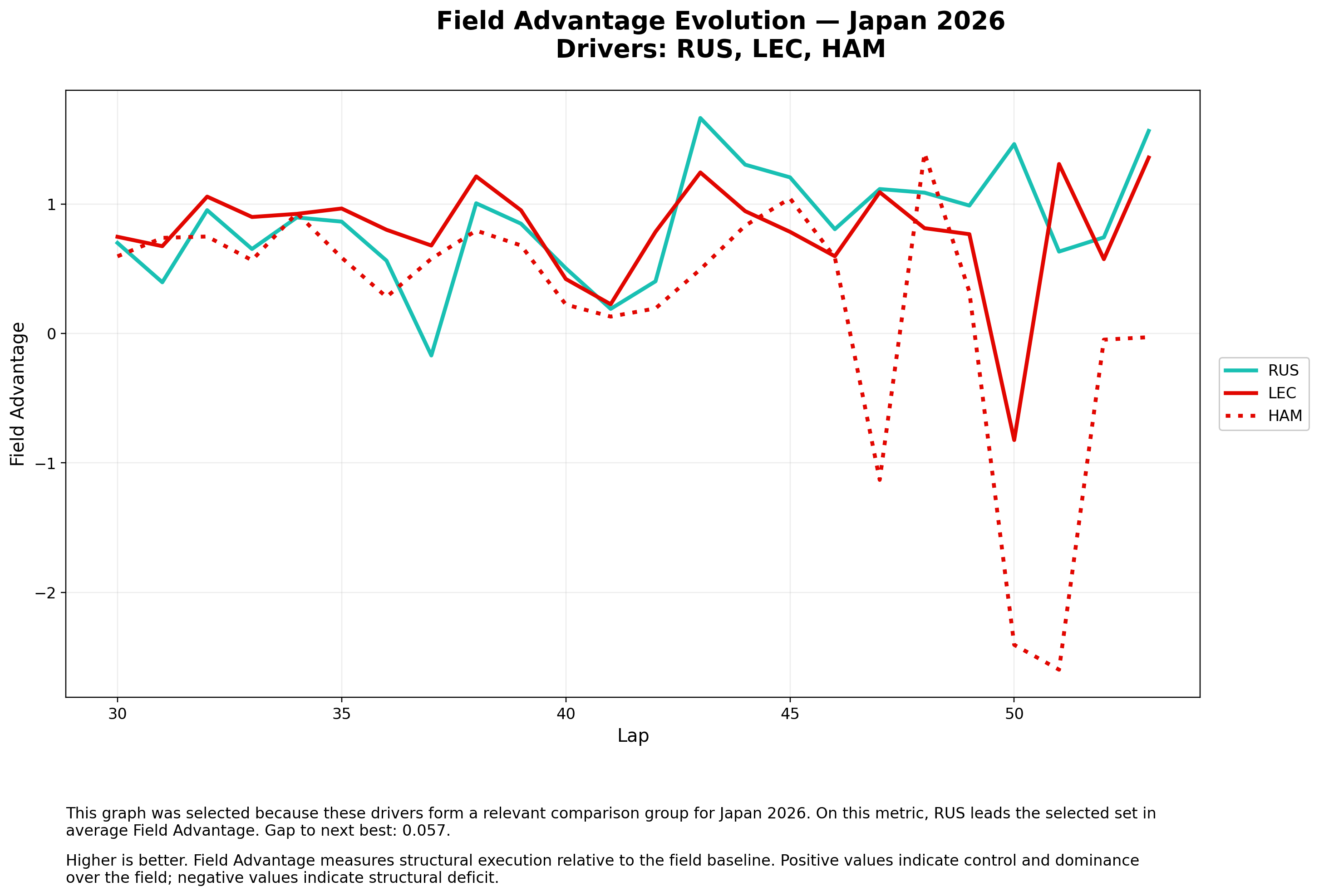
The closing podium phase shows Leclerc sustaining the stronger late-race structure under pressure from Russell and Hamilton. The podium was therefore defended through real control rather than passive survival.
Competitive Rank — Podium Fight
RUS · LEC · HAM · Laps 30–Finish
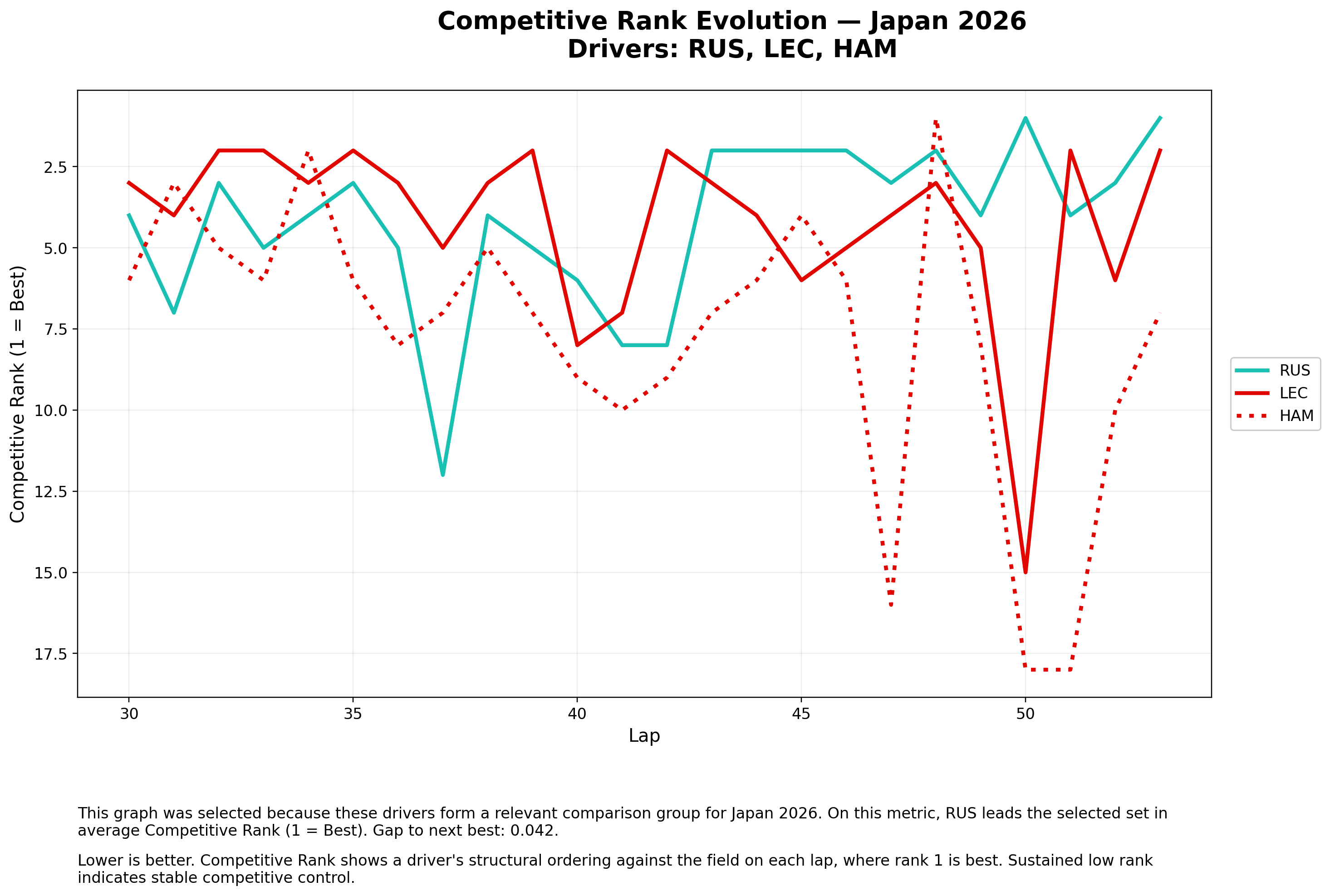
The rank signal confirms the same conclusion. Russell applies pressure, but Leclerc does not structurally lose control of the final podium layer.
Sector Intelligence
Japan sector analysis should now be added as the next layer. The race page establishes who controlled the event and where the decisive battle windows occurred. The sector layer should explain where that control was created and how the late podium defence was sustained.