Abu Dhabi 2025 — Championship Race Dynamics
Two decisive duels. One structural field. This page shows how pressure converts (or fails to convert) into position — using physics extracted from race timing.
Each panel is a structural measurement of the competitive field as it unfolded during the race. Driver execution, car constraint, degradation, and race-phase transitions appear as one observable outcome.
The objective is operational: isolate when pressure is being spent efficiently, when cost is building, and when conversion is structurally feasible — without requiring private telemetry.
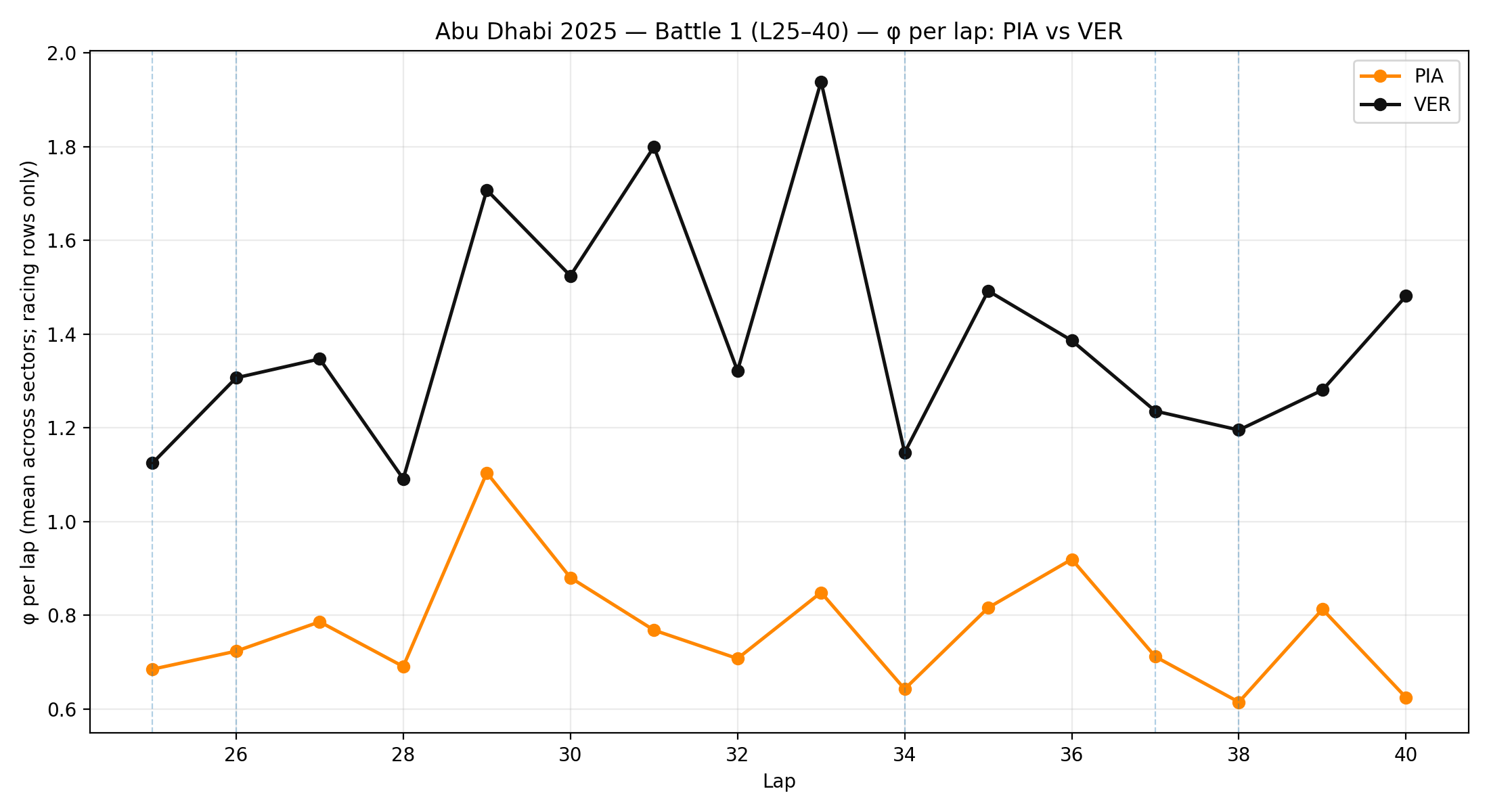
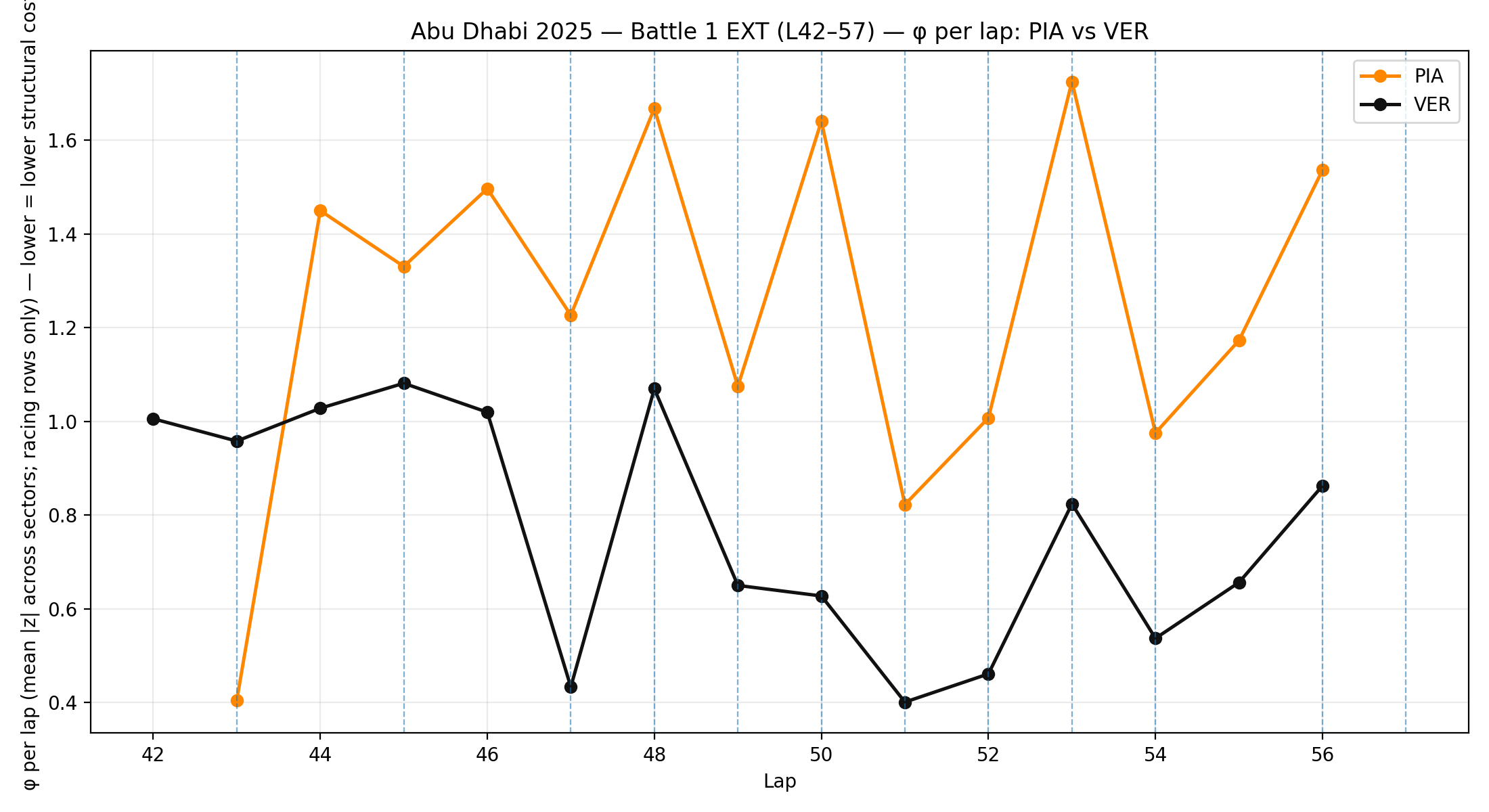
- SLI™ (φ) per lap = structural cost. Lower = cheaper control; higher = higher expenditure.
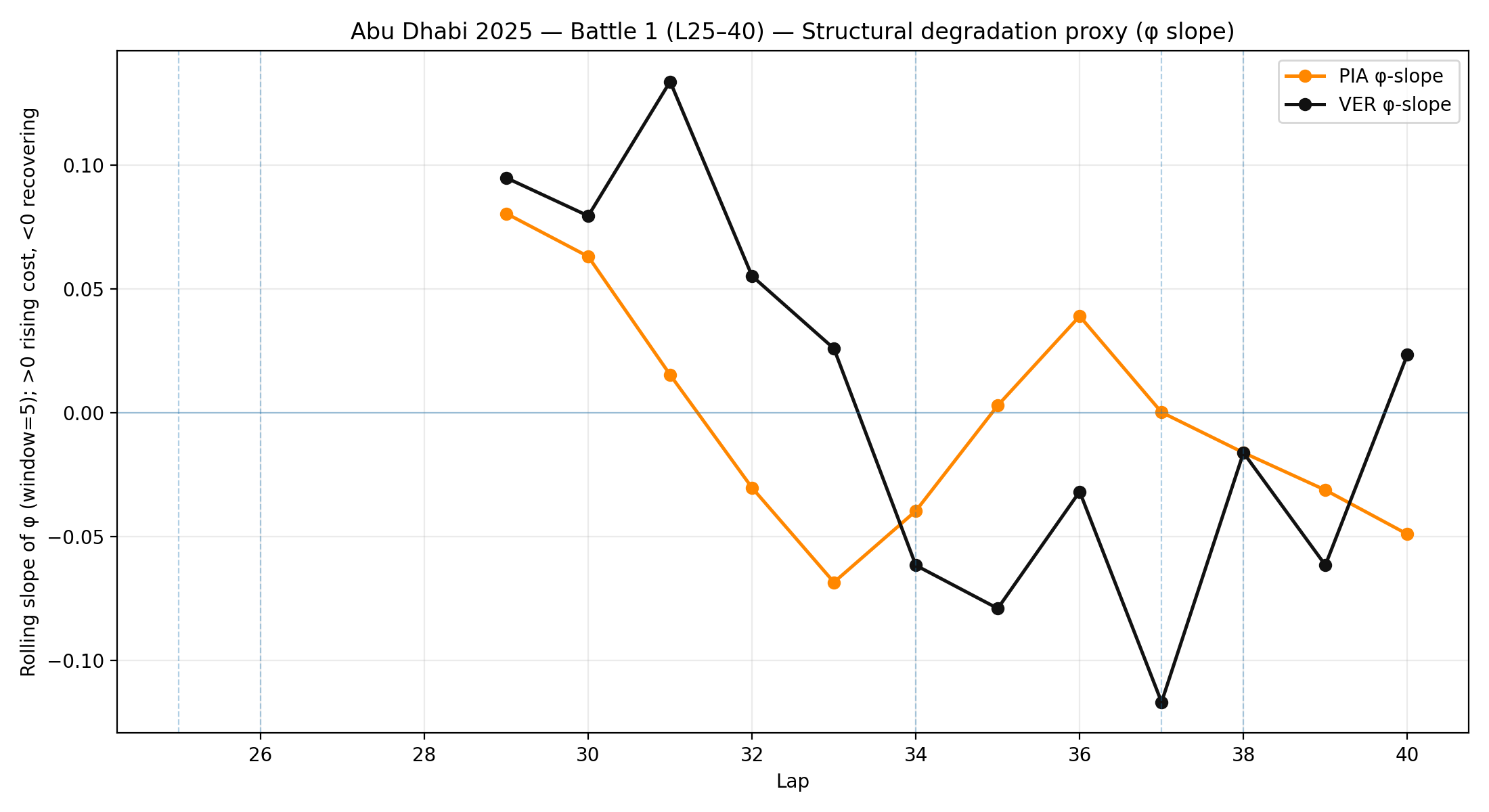
- DegS™ (Degradation Slope) = φ-slope (window=5). DegS > 0 means cost is building (worsening); DegS < 0 means stabilising/recovering.
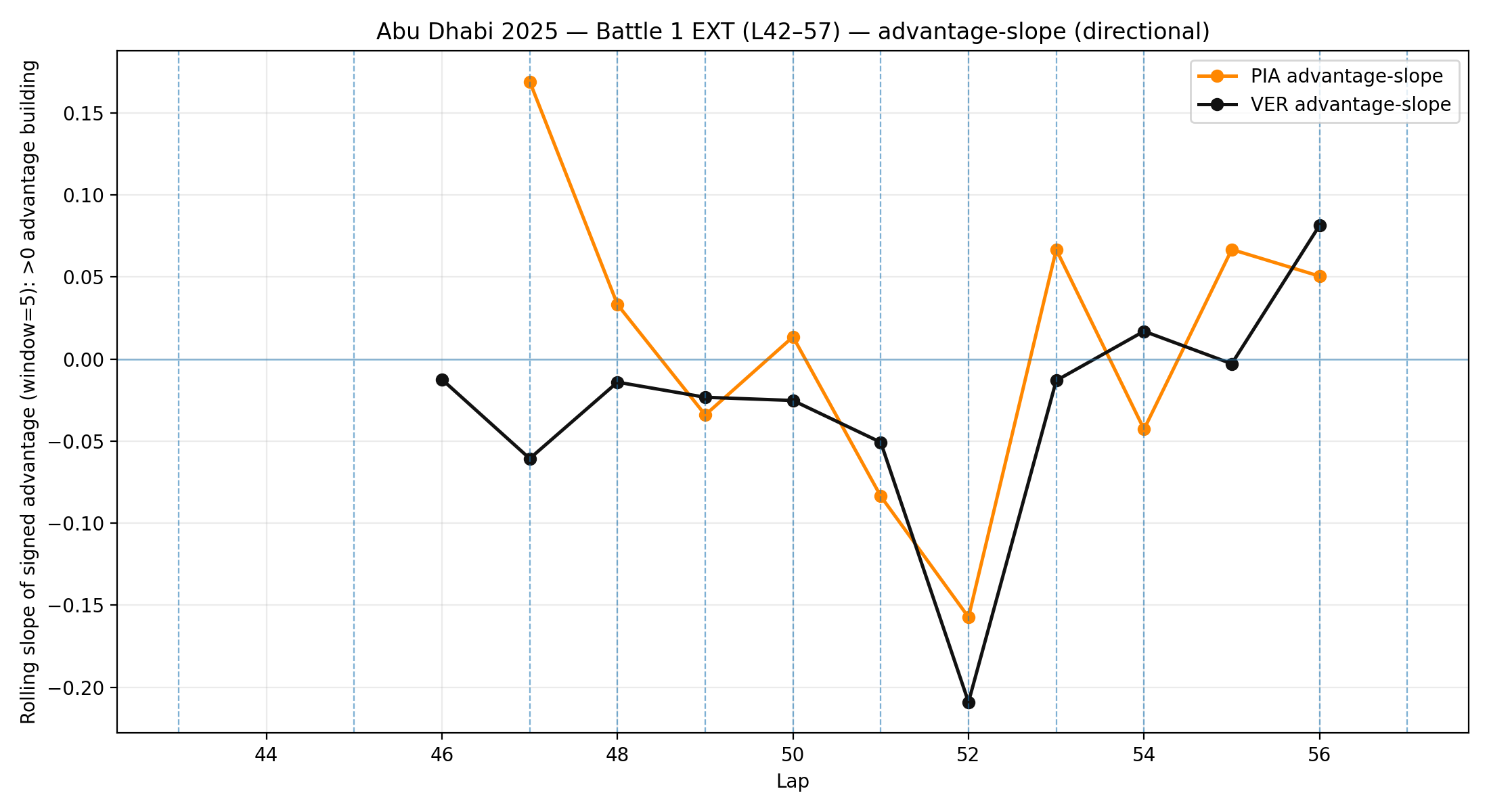
- AdvS™ (Advantage Slope) = advantage-slope (directional). AdvS > 0 means advantage is accumulating; AdvS < 0 means advantage is leaking.
Duel A — PIA ↔ VER (race leadership swing)
This duel is split into two phases: the chase to the overtake (L25–40), and the post-stop pursuit (L42–57). Together they show a complete structural cycle: pressure build → conversion → defence under pursuit.
Phase 1 (L25–40): VER resets tyres; PIA holds track position. The question: does PIA’s structure remain sustainable as VER escalates?
Phase 2 (L42–57): PIA resets tyres and attacks; VER defends. The question: does PIA’s structural expenditure convert into closure?
- DegS™ crossing flags when a stint stops being sustainably controlled.
- AdvS™ persistence shows whether pressure is converting or being absorbed.
Physics intelligence conclusion (race-operational)
Phase 1: DegS™ identifies the point where the leading stint stops being structurally stable. In this window, the DegS™ transition indicates that the optimal defensive choice would have been an earlier reset. Physics intelligence trigger: PIA pit target ≈ Lap 35 (DegS™ crossover).
Phase 2: After reset, PIA applies pressure, but VER remains inside the conversion envelope. VER sustains defence by keeping within PIA’s AdvS™ pressure band—pressure exists, but conversion does not accumulate into closure.
Duel B — LEC ↔ NOR (championship defence window)
This duel isolates defence under sustained attack. The key question is structural: does the defender maintain a stable envelope while the attacker spends structure attempting conversion?
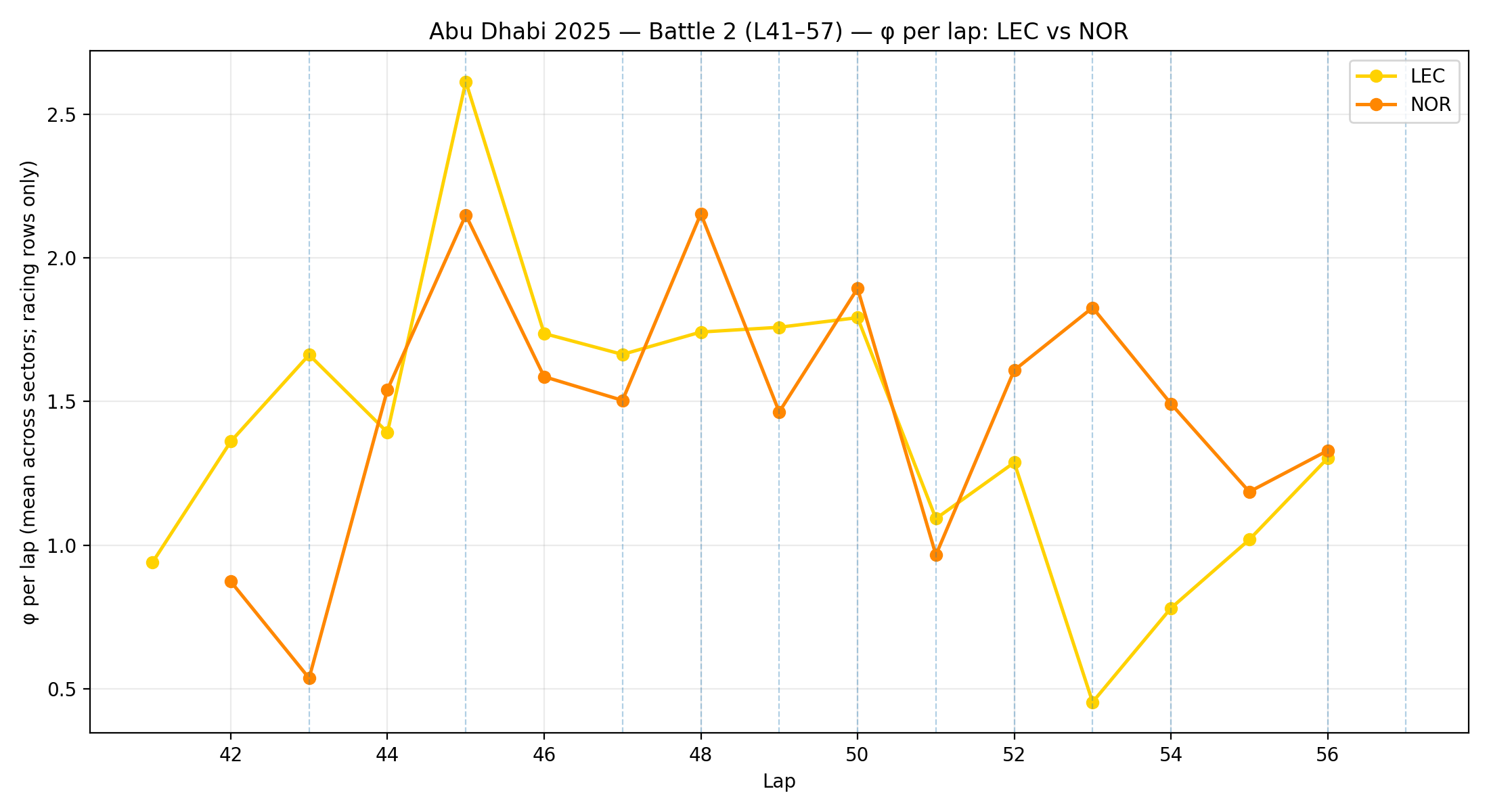
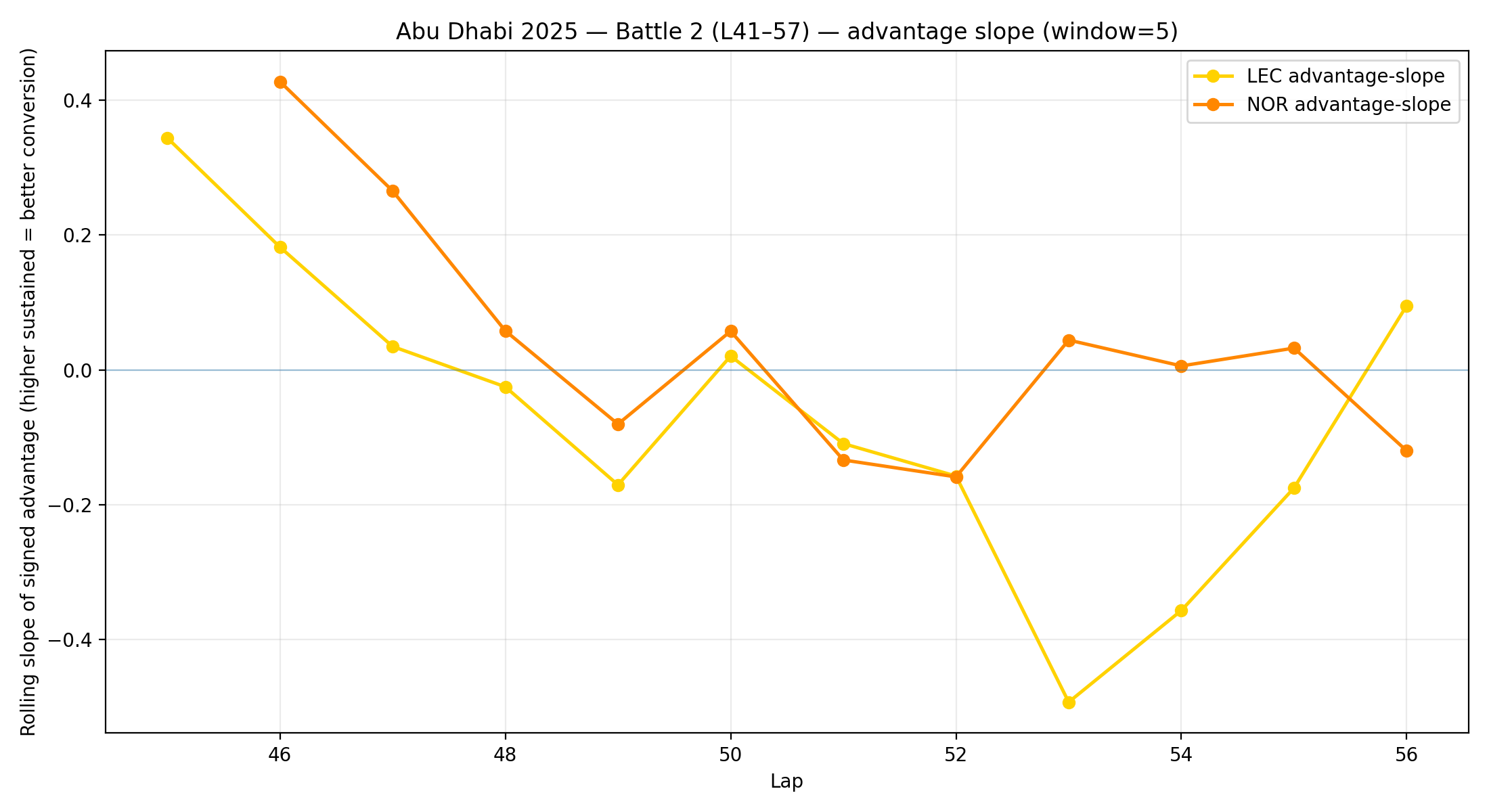
Physics intelligence conclusion (defence viability)
The defender does not need to “win” structure; the defender needs to keep conversion bounded. In this window, the structural panels show the defender maintaining a stable enough envelope to prevent conversion. Physics intelligence result: NOR operated at “sufficient control” to hold a safe margin — LEC escalation did not convert.
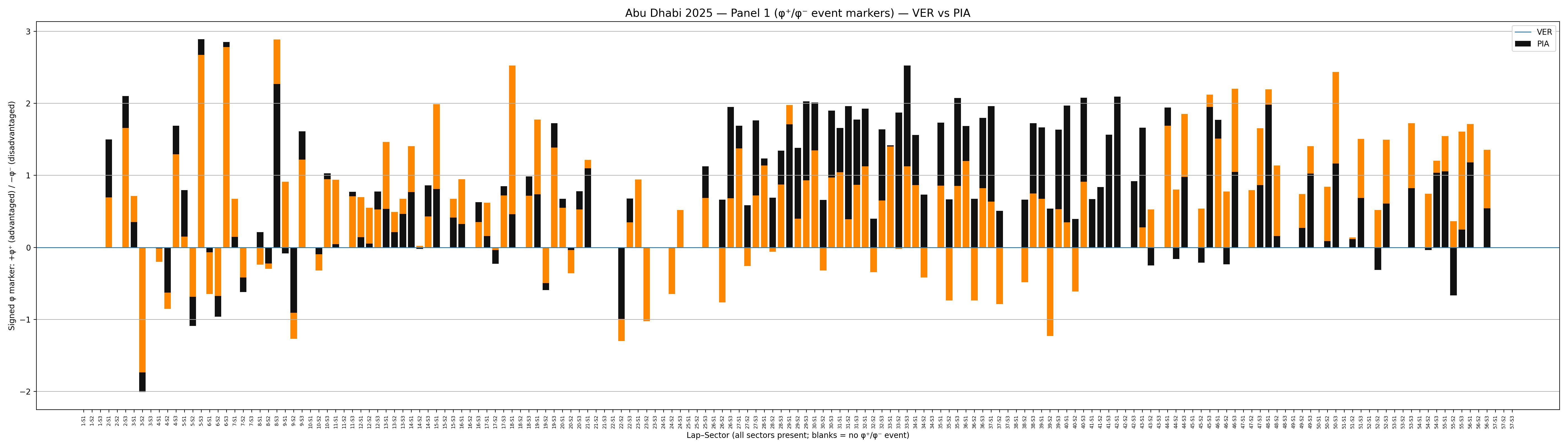
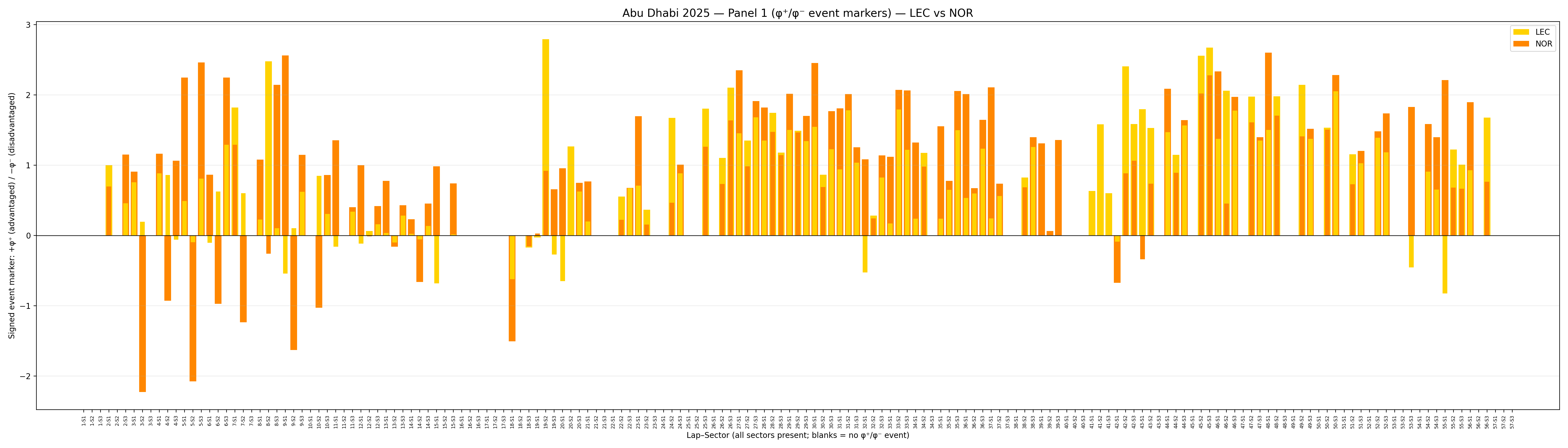
Panel 1 — φ⁺ / φ⁻ Event Markers (sector resolution)
φ⁺ marks an advantaged structural event at sector resolution. φ⁻ marks a disadvantaged structural event.
- > 0 (φ⁺) = advantaged event
- < 0 (−φ⁻) = disadvantaged event
- blank = no event marker for that sector (neutral band)
Sector events accumulate into lap-level behaviour. When φ⁺ events cluster with sustained AdvS™, pressure is converting. When φ⁻ events cluster while AdvS™ collapses, pressure is being absorbed or lost.
This panel is a direct live-product primitive: per completed sector, update the event marker stream and flag boundary crossings for immediate decision support.
Live instrument demo
In live mode, the monitor ingests sector timing as it arrives, updates φ / DegS™ / AdvS™ continuously, and emits structural alerts when a duel shifts from “controlled” to “convertible.” This turns raw timing into actionable structure state.