Racing Structural Physics
Racing Drivers Season 2025
Structural Advantage Field
What we measure
We measure field-relative structure as it emerges inside a live competitive grid. Driver execution, car constraint, degradation, and race phase transitions are expressed in the same structural field envelope — producing a coherent view of performance under pressure.
How to read
- SMI™ (φ-momentum) is computed per race. Higher indicates stronger structural advantage relative to the grid that weekend.
- Missing points indicate insufficient coverage (DNS / DNF / low scored rows), not a “bad result.”
SMI™ — Structural Momentum Index
Field-relative structural advantage per race weekend (2025 season).
The Structural Momentum Index (SMI™) is computed by running the QEIv18™ structural physics engine across every race of the 2025 season. SMI™ measures how competitive advantage accumulates and sustains over a full weekend, as observed by the racing field itself.
What is integrated into the field envelope
- structural load (SLI™ / φ)
- escalation and stabilisation dynamics (κ)
- degradation pressure and recovery behaviour
- race phase transitions (neutralisation / disruption markers)
- constraint interaction (car, strategy, environment) expressed through field response
Driver execution is evaluated inside the full competitive field. As a result, SMI™ represents total race performance: how efficiently pressure is applied, absorbed, converted, or resisted across an entire event.
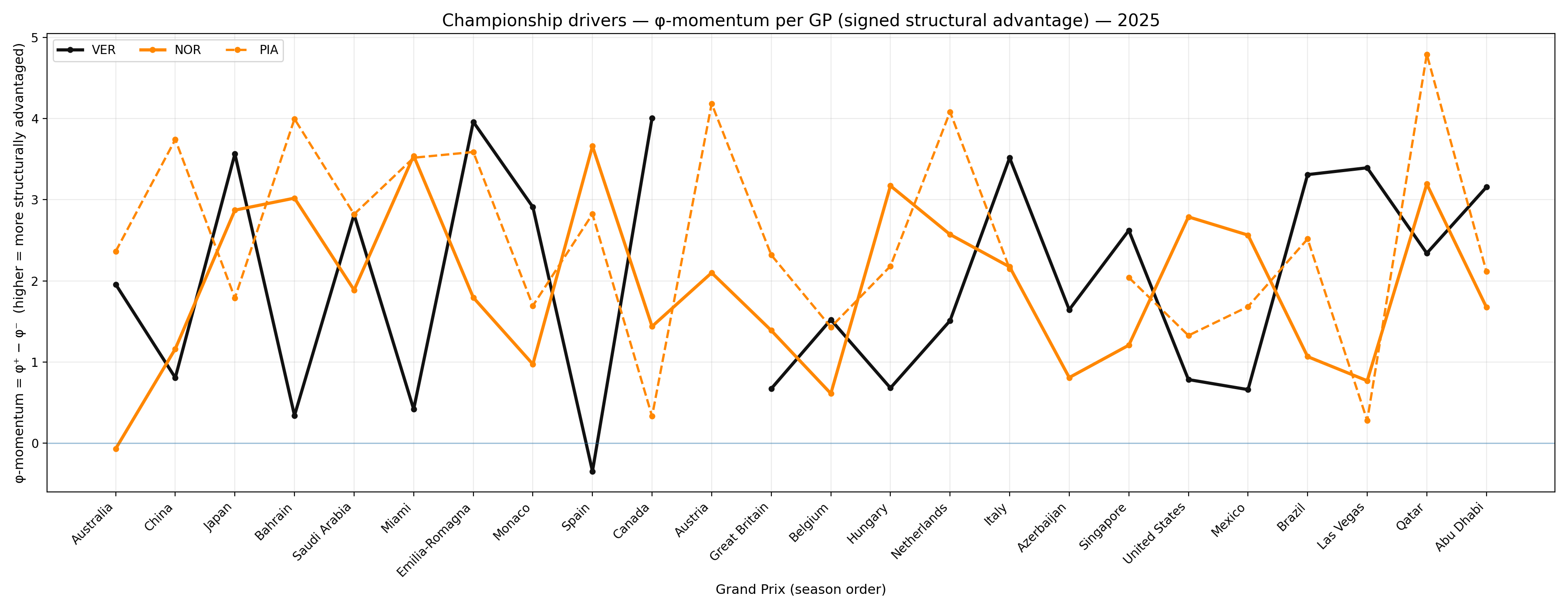
Championship Contenders — SMI™ per race (2025)
NOR · VER · PIA. Higher values indicate stronger weekend-level structural advantage relative to the full grid.
What stands out
The contenders separate by consistency of advantage. Peaks indicate weekends where pressure converted cleanly into field leverage. Shallow weeks indicate reduced conversion under constraint.
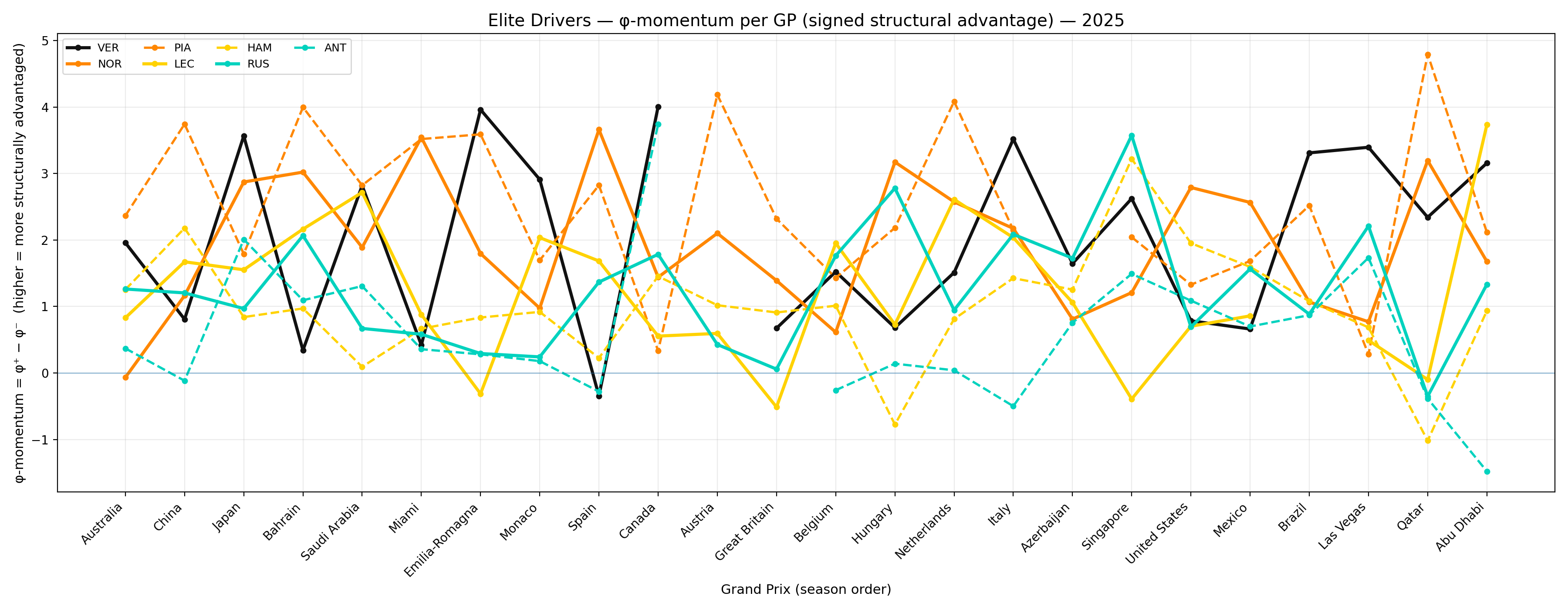
Elite Drivers — SMI™ per race (2025)
VER · NOR · PIA · LEC · HAM · RUS · ANT. Higher indicates stronger structural advantage relative to the field.
What stands out
Leaders maintain positive structural advantage across diverse race architectures. Drivers clustered near baseline show more neutral positioning: balanced control with less dominant leverage.
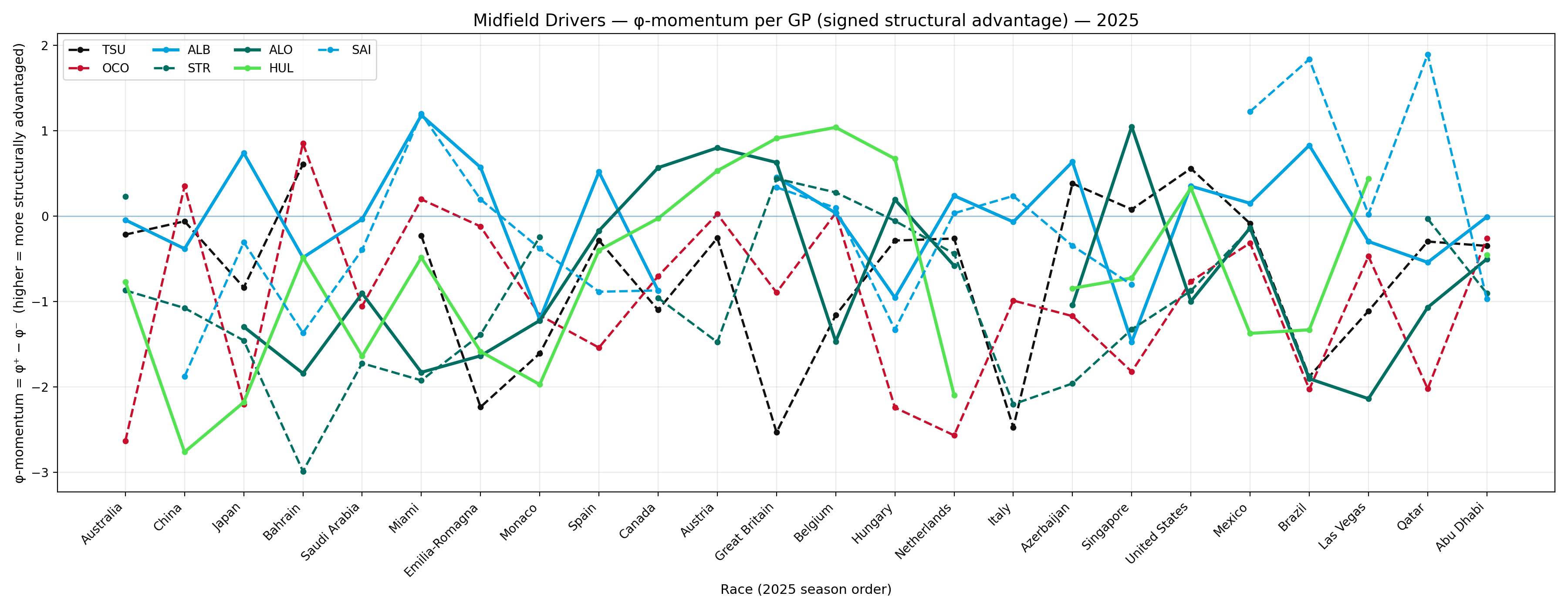
Midfield — SMI™ per race (2025)
TSU · OCO · ALB · STR · ALO · HUL · SAI. Measures structural advantage inside a resource-limited competitive band.
What stands out
Advantage is more intermittent and sensitive to local race phases. Sustained positive weeks typically indicate repeated extraction of structure under constraint rather than isolated pace.
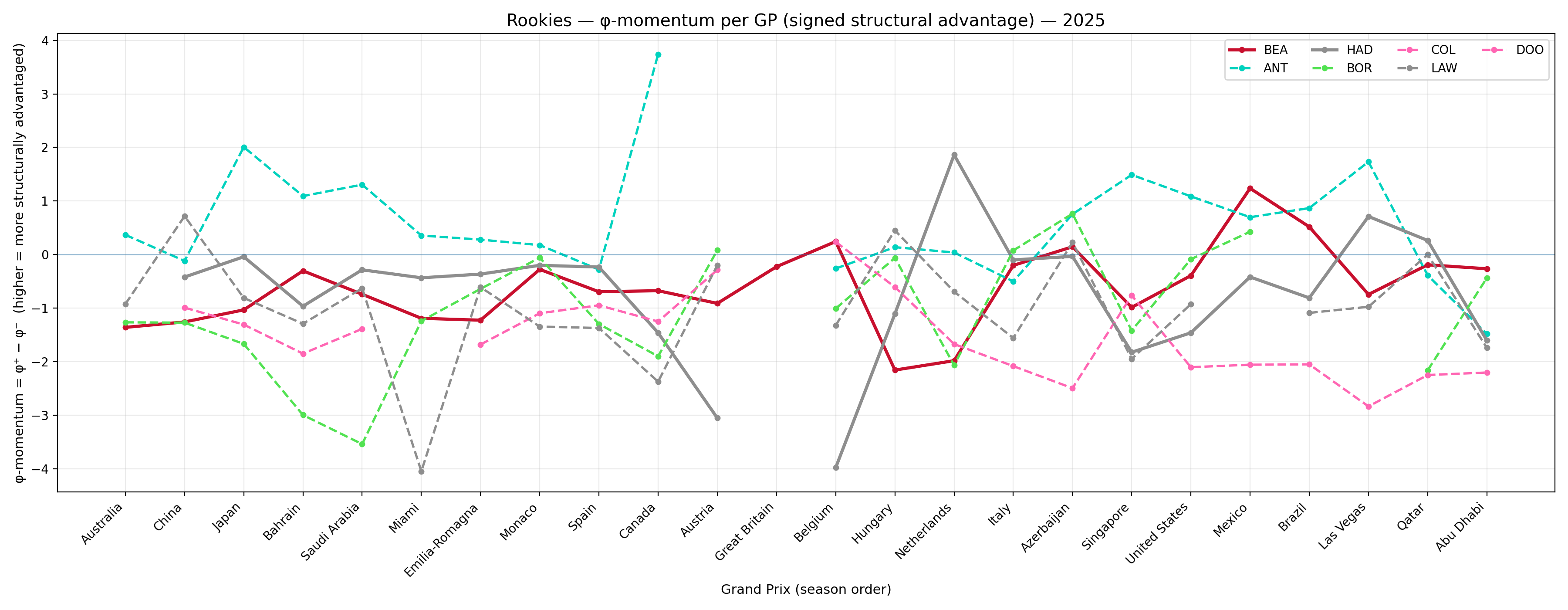
Rookies — SMI™ per race (2025)
BEA · ANT · HAD · BOR · COL · LAW · DOO. Tracks adaptation and stability under full-season exposure.
What stands out
Structural advantage stabilises as adaptation improves. Divergent weeks often reflect instability phases rather than raw speed.
Key takeaways — 2025 structural separation
Elite and championship contenders sustain positive momentum across diverse race architectures. Midfield drivers exhibit intermittent control with frequent structural resets. Rookies experience prolonged negative momentum as they absorb field pressure faster than it converts.
These patterns persist regardless of circuit type, weather, or strategy — indicating a persistent structural signal rather than situational variance.
These patterns persist regardless of circuit type, weather, or strategy — indicating a persistent structural signal rather than situational variance.